

This one is written for parents, because you are usually the person deciding whether a complaint about a sore hip is worth an appointment.
Dancers are athletes with an aesthetic requirement layered on top, and that combination produces injury patterns you will not see in other sports. I danced myself, I spent two years in London working with West End performers and musical theatre students, and I looked after the dance and music students at the Victorian College of the Arts Secondary School for three years. What follows is what I wish more parents knew earlier.
Four things make it unusual.
The ranges are extreme, and the loading happens at the very end of those ranges rather than in the middle where most sports operate. The repetition volume is very high. There is no genuine off season, and rehearsal periods intensify exactly when recovery is most needed, which is the opposite of how sport is periodised. And there is a long cultural history of working through discomfort, which is improving but has not gone away.
Add that most serious dancers are training hardest through their growth spurt, and you have a picture that a generic musculoskeletal assessment will often miss.
This is the section I most want parents to read.
During a growth spurt, bones lengthen before the muscles and tendons attached to them adapt. That means everything gets temporarily tighter, coordination drops, and a dancer who had a movement mastered six months ago can visibly lose it. Teachers sometimes read this as a lack of effort. It is not. It is developmental and it is temporary.
Bone is also at its most vulnerable during this window, which is why bone stress injuries cluster in adolescence.
What to watch for by age
The practical implication is unglamorous: during a rapid growth phase, holding training volume steady rather than increasing it is protective. Pushing harder through this period is what turns a manageable niggle into a season out.
Available turnout is largely determined by the shape of the hip joint, and it varies enormously between individuals. It is substantially inherited. No amount of stretching changes bone.
When a dancer forces turnout beyond what their hips allow, the extra rotation has to come from somewhere, and it comes from the knee, the foot rolling in, or the lower back. Over time that is where the pain appears, even though the origin is at the hip.
So when a dancer presents with knee pain, I assess their hip rotation range, because quite often the knee is the victim rather than the culprit.
What we do about it is measure the true available range, train within it, and strengthen the deep rotators so the dancer can actually use all of what they have. That usually produces a better looking line than forcing it, and it is far more sustainable.
Naturally flexible dancers are often selected for and praised early, and it is easy to assume this is an advantage.
Range without control is a liability. A hypermobile dancer can reach positions their muscles cannot yet control, which means the joint structures take the load instead. These dancers typically need more strength and more proprioceptive work than their peers, not more stretching, and they are frequently prescribed the opposite.
If your child is the one everyone comments on for their flexibility, that is a reason for a strength program, not a reason to relax.
Most aches in a dancer are unremarkable. These are the ones I would not wait on.
Worth mentioning carefully because it matters.
Bone stress injuries are more likely when the energy available to the body is not keeping pace with the training load. In a dancer training many hours a week, this is a real risk regardless of intent, and it is often about the mismatch rather than anything deliberate.
Other things that can point to it include repeated bone injuries, frequent illness, unusual fatigue, and in adolescent girls, periods that become irregular or stop. If any of that sounds familiar, the right next step is a GP, and often a sports dietitian alongside. It is a team problem rather than a physiotherapy one, and it is very treatable when it is picked up early.
When a dancer is injured, I try to speak with their teacher, with your permission. It changes outcomes.
The reason is that rest is rarely the right prescription and is almost never followed anyway. Modified participation keeps conditioning, technique and, importantly, the dancer's connection to their group. A dancer sitting at the side of the studio taking notes is in a much better position than one sitting at home.
What I usually send is specific: which movements are fine, which are off for now, and roughly for how long. Teachers are generally very willing to work with that when it is clear.
If something has been going on for more than a couple of weeks, book an assessment and bring your dancer's weekly schedule, including all styles and all studios.
Usually not. Modified participation is nearly always preferable, and full rest is reserved for specific situations like a confirmed bone stress injury. Complete stops also tend to be followed by a return to full load, which is exactly the pattern that causes reinjury.
Painless clicking is extremely common in dancers and usually needs no treatment at all. Clicking accompanied by pain, or a sense of the joint catching or giving way, should be looked at.
There is no single number, because it depends on the dancer, their age and their history. What matters far more is the rate of change. A jump from six hours to fourteen at the start of an exam or eisteddfod term is the pattern that causes problems, more so than the fourteen hours itself.
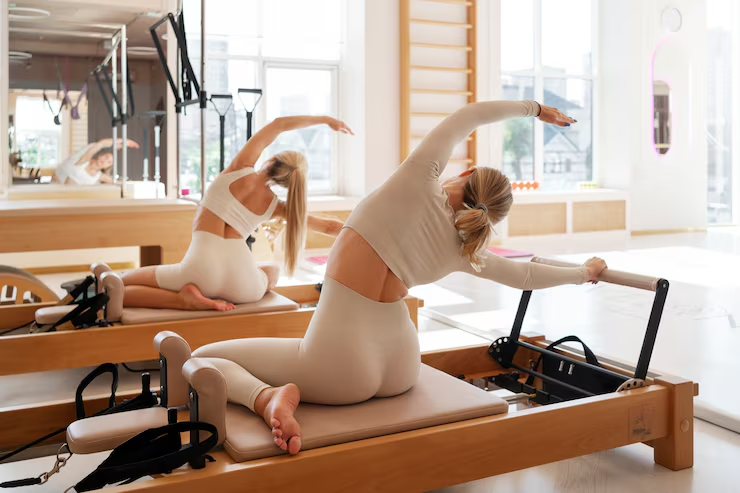
Yes, and it fits dance particularly well because the movement vocabulary overlaps so much. It is especially useful for hypermobile dancers who need control through their available range. I have been teaching Polestar Clinical Pilates since 2006 and most of my dancers do some.
Usually the opposite. Most young dancers I see need strength through range far more than they need additional range. If the flexibility is already there, more stretching adds risk without adding capability.
When readiness is assessed properly, yes. Readiness is about ankle and foot strength, control and maturity rather than age or how long someone has been dancing. A pre-pointe assessment is a genuinely worthwhile appointment.
Almost never. My job is to keep dancers dancing, and the overwhelming majority of what I see is manageable within a training schedule.
After more than twenty years of this, the pattern is clear enough to state plainly. The dancers who have long careers are rarely the ones who trained hardest as teenagers. They are the ones who managed their load intelligently, dealt with problems early rather than hoping, and built strength alongside their flexibility rather than instead of it.
You can book an assessment at our Elsternwick clinic. We see dancers from studios across the south east, and I am happy to liaise with teachers where it helps.
Book with Kristen


By signing up to receive email from core, you agree to our privacy policy. we treat your info responsibly. Unsubscribe anytime.



















.jpeg)