Being told to stay active during cancer treatment can feel like advice from someone who has not met you, particularly on the days when getting off the couch is the achievement.
I want to be clear about what this actually involves, because the phrase exercise during treatment sounds enormous and the reality is usually much smaller and much more manageable than people picture.
I am a certified PINC Cancer Rehabilitation practitioner, which is a program designed specifically for women recovering from cancer treatment. Here is how it works and who it suits.
Cancer treatment affects the body well beyond the tumour itself. Chemotherapy and radiotherapy commonly bring fatigue, loss of muscle, reduced bone density, changes in balance, and deconditioning of the heart and lungs. Surgery adds scar tissue, restricted range of movement, and for many people a changed relationship with a part of their body.
Appropriately prescribed exercise addresses every one of those. The evidence is strongest for cancer related fatigue, where graded activity consistently outperforms rest. That is counterintuitive enough that it is worth saying twice, because rest is what everyone's instinct suggests and it is the one thing that reliably makes the fatigue worse.
People before treatment, who want to go in with more capacity. People midway through chemotherapy or radiotherapy, working around their cycle. People who finished treatment six months ago and are wondering why they still do not feel like themselves. And people who finished five years ago and never got any guidance at all.
There is benefit at every one of those points. The earlier the better, but later is not too late.
The first appointment is long, usually an hour, and most of it is talking.
I need to understand what treatment you have had or are having, what your surgeon has said, where your scars are, whether lymph nodes were removed, how your energy moves across a typical week, and what you actually want to get back to. That last one matters more than anything on the clinical list.
Then a physical assessment appropriate to where you are. Range of movement, particularly through the shoulder and trunk after breast or abdominal surgery. Strength. Balance. How you are tolerating everyday tasks.
You leave with a written program and a realistic sense of what the next six weeks looks like. Not a generic handout.
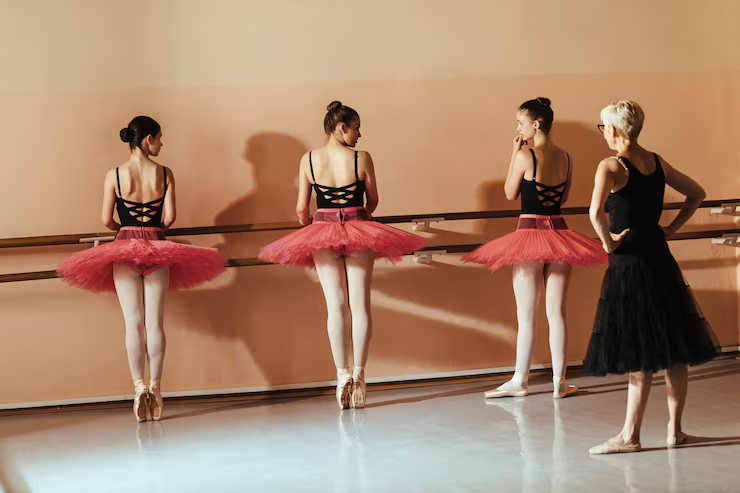
Sessions can be one to one, or through Clinical Pilates in a small group once you are ready for it. Many people move from individual sessions into a small group as their confidence returns, and the group turns out to matter for reasons that are not entirely physical.
If you are still in active treatment, we plan around your cycle rather than fighting it.
Most people find they can do noticeably more in the days before their next infusion and considerably less in the days immediately after. So we write a program with a heavier week and a lighter week built into it, and the lighter week is not a failure. It is the plan.
Sessions get shortened, or moved, or done at home, and none of that is a problem. Consistency across months is what produces the result, not any individual week.
The most common pattern I see is the good day problem. You wake up feeling like yourself for the first time in a fortnight, so you do the washing, the shopping, see a friend and cook dinner, and then you pay for it across the following three days.
Doing a moderate amount on a good day, and stopping before you are finished, is a genuine skill. It feels wrong. It is the difference between a slow upward trend and a sawtooth that goes nowhere.
This is one of the things I spend the most time on, and it is the piece people tell me later made the biggest difference.
If you are somewhere in this and unsure where to begin, book an initial assessment and we will work out a starting point together.
In most cases yes, with the program adjusted around your treatment schedule. There are situations where we pause, such as very low blood counts, and we will work those out with your treating team.
This is the most common worry and the research is genuinely reassuring. Cancer related fatigue responds better to graded activity than to rest. The key word is graded, which is why the dose is prescribed rather than guessed.
Current evidence supports progressive resistance training after lymph node surgery, introduced gradually and monitored. This advice has changed considerably over the past two decades, and if you were told years ago to avoid lifting on that side, that guidance has been superseded. We will still work within whatever your surgeon has specified for you.
We recommend letting your treating team know either way, and there are situations where we will ask for clearance before starting, including very low blood counts, bone metastases or recent surgery. Bring whatever information you have and we will sort it out.
Then we start from there. A meaningful proportion of the people I work with were not exercising before diagnosis, and the program is built around what you can do now rather than what anyone thinks you should be able to do.
Sessions are delivered by a physiotherapist and are claimable under physiotherapy extras cover. If you have a Chronic Disease Management plan from your GP, you may also be eligible for a Medicare rebate for a limited number of sessions. Your GP can advise on that.
Any surgical or oncology correspondence you have, a list of your medications, and comfortable clothing. That is all.
The only principle that really matters is that the starting point is set by today, not by what you used to do. For someone midway through treatment that might be a few minutes of gentle movement and some breathing work. For someone two years out it might be a full strength program.
Both are the right program. They are just different weeks in the same process.
You can book an assessment at our Elsternwick clinic, or get in touch if you would like to ask something first. There is no obligation, and it is a very normal thing to want to talk through before booking.
Booking by Request only


By signing up to receive email from core, you agree to our privacy policy. we treat your info responsibly. Unsubscribe anytime.















.jpeg)