

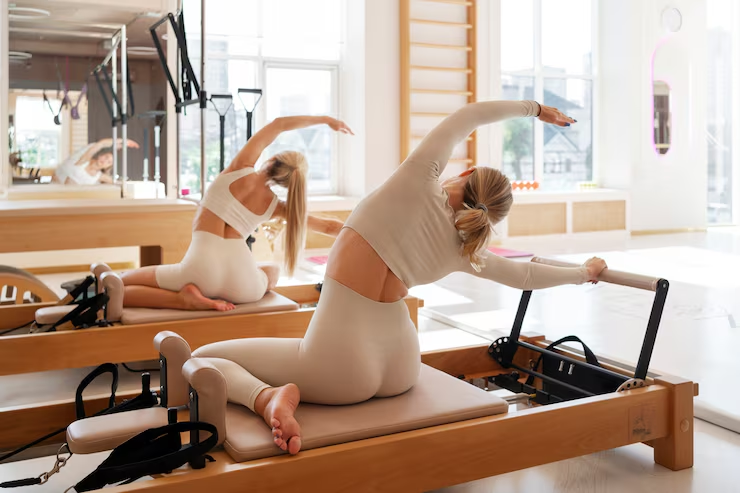
Neither reformer nor mat Pilates is better. Reformer suits you if you are rehabilitating an injury, lack confidence in a movement, or want resistance in positions that are hard to load otherwise. Mat suits you if you want something portable, want to build control against your own body weight, and want to practise between sessions. Most people who stick with Pilates end up doing both.
I have been teaching both formats for over a decade, and the question I get in the studio is almost never which is better. It is which one should I start with, which is a much better question and has an actual answer.
The thing almost everyone gets backwards
People assume the reformer is the advanced option because it is a machine with springs, and that mat is the beginner version because it is a mat on the floor.
It is the other way round more often than not.
The springs on a reformer can resist a movement, but they can also assist it. That second function is the one that matters clinically. If you cannot yet control a movement through full range, the spring will hold part of your body weight and let you work in a range you could not manage unsupported. That is why we use it so heavily after surgery and in the early stages of rehab.
Mat work has no such assistance. It is you, gravity and your own body weight, which means there is nowhere to hide. Some of the hardest exercises in the entire Pilates repertoire are done on a mat with no equipment at all. Anyone who has attempted a proper teaser will tell you the same.
So when someone tells me the reformer looks intimidating, I usually say the machine is the thing most likely to make it feel achievable.
Where the reformer earns its place
Support when you need it. Post surgical knees, irritable backs, shoulders that will not tolerate load overhead. The springs let us start meaningful work far earlier than we otherwise could.
Load in unusual positions. You can work the legs hard while lying down, which is genuinely useful when standing is the thing that hurts.
A moving surface. The carriage slides, so every exercise carries a control challenge on top of the strength challenge. A stable floor cannot replicate that.
Fine gradation. Changing a spring is a small, precise change in difficulty. It lets us progress people in increments that a mat class simply cannot offer.
Where mat work earns its place
It travels. Your lounge room, a hotel, the floor next to a cot at 6am. I have two young girls, and the honest truth of the last few years is that the exercise which actually happens beats the exercise I would theoretically prefer.
It builds real self-reliance. Without spring assistance you have to organise your own body. That skill transfers to everything else you do.
It exposes what you are avoiding. On a reformer it is possible to let the machine do a bit of the organising for you. On a mat that option disappears, which is uncomfortable and useful.
It is the cheaper way to get volume. Two studio sessions a week plus mat work at home will always beat two studio sessions a week alone.
Which should you start with?
Find yourself in this list.
You are recovering from surgery or a significant injury. Reformer, in a physio-led session, and probably one to one at first. The assistance is the whole point.
You have back pain that flares with standing or walking. Reformer initially. Working in supported positions lets you build strength without provoking the thing that hurts, then we transition you upright.
You are generally healthy and want to get stronger. Either. Genuinely. Pick the one you will show up to consistently, because that variable outweighs the equipment by a distance.
You are pregnant or recently postnatal. Reformer, with modifications, and tell us where you are at so the program is adjusted properly. Mat work slots in later as a home practice.
You are hypermobile. Reformer first. Hypermobile bodies need feedback and control rather than more range, and the springs give you something to push against and organise around. Unstructured mat work often just takes you further into ranges you already have too much of.
You travel constantly or your schedule is unpredictable. Learn on the reformer for a block, then build a mat routine you can do anywhere. That combination is the one I recommend most often.
Where Clinical Pilates fits
Both formats can be delivered as a general class or as Clinical Pilates, and the difference is not the equipment. It is what happens before you start.
Clinical Pilates follows a physiotherapy assessment. The program is written for your specific condition, your history and your goals, and it is adjusted as you progress. At our Elsternwick studio these sessions are physiotherapist-led and capped at four people, which means the program is genuinely individual rather than a shared routine with individual modifications shouted over the top.
A general class is not lesser. It is just a different product. If you have an injury, a diagnosis or a surgery in your history, start clinical. If you are well and want to move, a general class is a perfectly good place to be, and it usually costs less.
You can see the current Pilates timetable for both formats, or book an assessment if you are not sure where you belong.
Three things people get wrong
Waiting until they are fit enough to start. Nobody has ever been turned away for being unfit. Flexibility and strength are outcomes of Pilates, not entry requirements. A large share of people start precisely because they cannot touch their toes.
Treating the reformer as a cardio class. If you leave every session soaked and shaking but no better at controlling your body, something has gone sideways. Pilates is a control and strength method. Intensity has its place, but it is not the point.
Chasing variety over progression. A new sequence every week feels great and builds very little. Repeating an exercise until it becomes easy, then making it harder, is what changes your body. This is the single most common reason people plateau.
Common questions
Which is better for lower back pain?
The research does not favour one over the other, which tells you the equipment is not the active ingredient. What matters is that the program matches your presentation and progresses appropriately. A well designed mat program beats a poorly designed reformer session every time.
How often do I need to go?
Twice a week to build strength and control. Once a week to maintain what you have. Consistency across months matters enormously more than intensity in any single session.
Can I claim it on private health?
Clinical Pilates sessions delivered by a physiotherapist are claimable under physiotherapy extras cover. General classes are not. Rebates vary by fund and level of cover, so check directly with yours.
What should I wear and bring?
Fitted clothing so we can see how you are moving, and grip socks, which are required on the reformer. That is it.
Just try one
Most people have a preference, and in my experience it is rarely the one they predicted before they started. The reformer sceptics tend to become reformer devotees. The people who booked reformer because mat looked too easy often discover otherwise about four minutes in.
If you are unsure, an assessment will point you to the right starting place, and nothing stops you changing your mind afterwards.