

I have been using dry needling at Core since 2017, and I have heard the same six things said about it for nearly a decade. Some are half true. Some are not true at all. Here they are, answered properly and briefly.
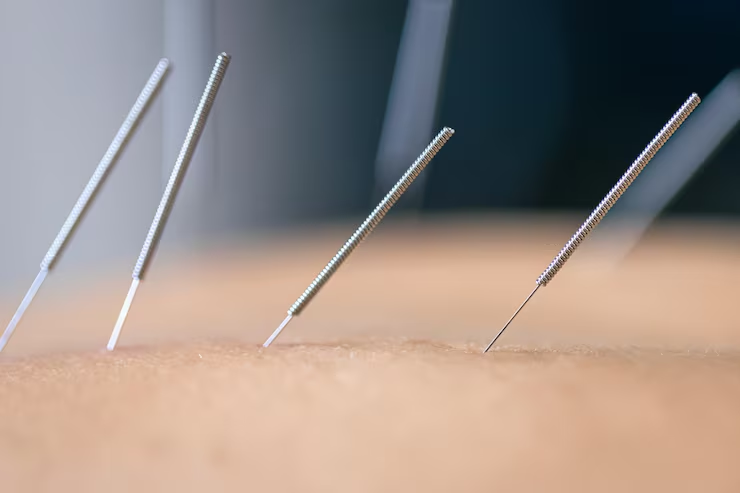
Quick definition first. Dry needling uses a fine, sterile, single use needle inserted into muscle, usually into a taut band or a tender point identified during assessment. It is called dry because nothing is injected. The needle is the treatment.
It is just acupuncture with a different name
No. The needles look similar and that is where it ends.
Acupuncture works from traditional Chinese medicine and meridian theory. Dry needling works from Western anatomy and targets a specific muscle that I have just assessed and found to be part of your problem. Different reasoning, different point selection, different intent.
Both can be useful. They are not the same treatment.
It is going to hurt
Less than you are imagining. These needles are dramatically finer than the ones used for injections or blood tests, and most people do not feel the insertion at all.
What you might feel is the twitch. When the needle finds a taut band, the muscle can respond with a quick involuntary contraction, and it is a strange sensation, a brief deep cramp that releases in a second or two. People describe it as odd rather than painful, and it is usually the moment they say that was the spot.
Some muscle soreness the next day is normal. It feels like you did a hard session at the gym.
It will fix my problem
This is the one I push back on hardest, and it is the reason I am writing this.
Dry needling reduces muscle tension and pain sensitivity. That is real and it is useful. What it does is open a window where you can move better than you could an hour ago.
It does not tell you why that muscle was overloaded. Something put it there. A training error, a weakness further up the chain, a job that keeps you in one position for nine hours, a movement habit. If nobody addresses that, the muscle goes straight back to being tight, and you come back in three weeks, and we do it all again.
The needling is the door. The exercise is walking through it. I care much more about the second part.
So I will need to come in every week
You should not, and if someone is needling you weekly for months with no exercise plan running alongside, ask them what the plan is.
In my hands it is usually front loaded. The first few sessions, while pain is the thing limiting your movement, then progressively less as your rehabilitation takes over. If you are three months in and needling is still the main event, something has gone wrong with the reasoning.
Is it actually safe
In trained hands, yes. Physiotherapists using dry needling complete specific postgraduate training in technique and anatomy, which matters most around the chest, neck and shoulder where the anatomy is unforgiving.
Needles are single use and go straight into a sharps container. Minor bruising is the most common side effect, occasionally a bit of light headedness on the first go, which is why I will have you lying down.
It is not covered by my health fund
It is. Dry needling is delivered inside a physiotherapy consultation, so it is claimable under physiotherapy extras cover exactly like the rest of your appointment. There is no separate charge for it at Core.
What the appointment actually looks like
- We talk, and I assess. Needling is never the starting point. I need to know which muscle is involved and why before a needle comes out.
- I explain what I want to do, which muscles, and roughly how many needles. You can say no to any of it.
- You lie down. Skin is cleaned. The needle goes in, usually left in place for a short period, sometimes moved slightly to find the band.
- Needles out, counted, disposed of. This part takes a few minutes, not the whole session.
- We use the window. Movement, loading, the exercises that are actually going to hold the change. This is the bulk of your appointment.
Who I will not needle
Not everyone is suitable, and I would rather say so upfront. I will avoid or modify if you are on blood thinning medication, have a needle phobia, have a bleeding disorder, have lymphoedema in the area, are pregnant and the target area is one we avoid, or have a skin infection or significant immune compromise.
None of these leave you without options. There is a great deal we can do with hands-on work, loading and Clinical Pilates, which is where I do most of my thinking anyway.
And if you simply do not like the idea of needles, that is a complete answer. You will not be talked into it.
Worth a try if
If you have a muscle that keeps tightening up and nothing seems to shift it, dry needling is worth a conversation. Just come in expecting a plan rather than a procedure.
Book an appointment at our Elsternwick clinic, or have a look at what else we offer if you would rather start somewhere else.